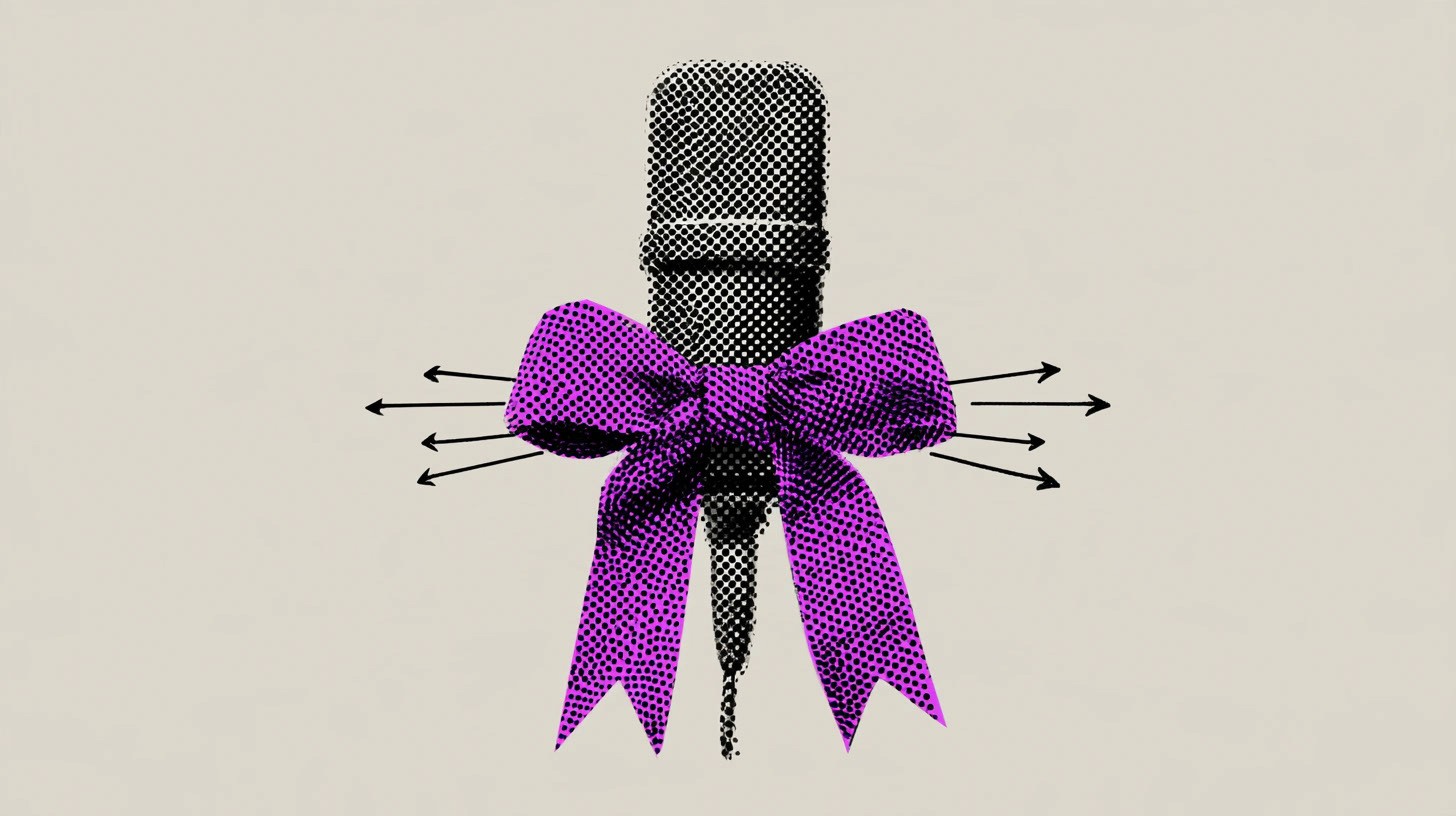

A gift that you only look at once is not a gift. It is a gesture.
The question no one likes to answer
A partner leaves after more than two decades. A managing director says goodbye after thirty years. The company turns fifty.
And then someone is in a position of responsibility and has to decide what to do about it.
The usual answers are quickly found. A watch, voucher, bouquet of flowers, or even a commemorative publication. A framed picture with signatures. In a better case, a short "little film."
The problem is not that these things are bad. The problem is that they do not match the significance of the occasion. Someone has put twenty years of their life into this company. And they receive something that you look at once and then put on the shelf.
What Klenk & Hoursch did instead
The Frankfurt-based communications agency Klenk & Hoursch faced exactly this situation. A partner was retiring after 21 years.
Instead of a speech and a photo book, a podcast series was created. Ten episodes. Title: “21 Good Years”.
Ten episodes of around thirty minutes each. With its own intro, its own transitions, its own outro. None of it was off-the-shelf standard; everything was built for this one occasion and this one person. That is the difference between a recording and a gift: with a gift, you notice how much care went into it.
It does not tell the history of the agency. It tells the story of a person and what they built, from the perspective of those who were there. Companions, colleagues, partners. People who had something to tell and who were given space for it for the first time.
The result is not a marketing product. It is a genuine gift. And it has a quality that no photo book has: you listen to it again. And you pass it on. A release schedule enables a streaming experience that maintains the connection far beyond the farewell.
Why content gifts have a different impact
They honor an achievement instead of summarizing it.
A commemorative publication writes: He shaped the agency for over twenty years. A podcast lets ten people tell exactly what that looked like. The difference is not length. It is depth.
They capture what would otherwise be lost.
In every company, there is knowledge that only exists in people's heads. Why a decision was made that way back then. How a customer was won. What really happened in a crisis. When someone leaves after twenty years, that knowledge goes with them. Unless it was recorded.
They work both internally and externally.
A farewell gift is primarily for one person. But the episodes can also go to employees, to new colleagues, to customers. A gift becomes a piece of company history that remains tellable.
People open up differently at the microphone than in front of the camera.
This is an observation that audio producers regularly make: a microphone is less intimidating than a lens. People forget about it after a few minutes and speak more freely. For a gift that lives on real memories, this is crucial.
Which occasions are suitable
Company anniversaries, usually for the 10th, 25th, 50th, or 100th anniversary. Farewells of managing directors, board members, or long-standing employees. Handovers in family businesses, when one generation hands over to the next. Milestone birthdays of shareholders. The completion of a major project or an era.
These occasions have three things in common: there is an achievement to be honored. There are people who can tell stories about it. And there is a point in time after which it is too late.
The point at which you have to decide
A content gift needs lead time. Not much, but it needs it. You need to know who should speak. You have to reach these people before the date arrives. And you have to record while the memories are fresh and the participants are still with the company.
This is the real reason why most companies stick to the watch and the photo book: not because they think it's better, but because the decision is made too late.
Anyone who has an anniversary or a farewell in their calendar for next year should ask this question now. Not the month before.
Frequently asked questions
What is a content gift?
A content gift is a produced media format created for an occasion that outlasts it. Typical formats include podcast series, documentaries, or audio narratives in which companions speak about a person, a company, or a shared history. Unlike a commemorative publication or photo book, it is used repeatedly and passed on.
How long does production take?
That depends on the scope. For a multi-part series, you should expect a few weeks, from concept and interviews to the final edit. The production time is less critical than the lead time: the interviews must be conducted while the right people are reachable.
Does such a gift remain private or is it published?
Both are possible. Many companies produce exclusively for the internal circle, as a private feed or as a file. Others publish individual episodes later, for example, for the company anniversary or in recruiting. This decision should be made before production, as it influences how interviews are conducted.
For what company sizes is this worthwhile?
The effort scales with the scope, not with the size of the company. What matters is whether there is a story worth telling and people who can tell it. Both exist in family businesses just as much as in corporations.
Wrap-Up
For anniversaries and farewells, companies usually resort to a watch, voucher, or commemorative publication. All three have the same problem: you look at them once. Klenk & Hoursch had a ten-part podcast series produced instead for a partner's farewell after 21 years, thirty minutes per episode, with its own intro, transitions, and outro.
A content gift honors an achievement instead of summarizing it, captures knowledge that would otherwise leave with a person, and remains tellable. The only critical factor is lead time: the decision must be made before the date arrives.
Do you have an occasion in your calendar?
If an anniversary, a farewell, or a handover is coming up in the next year, an early conversation is worthwhile. We will clarify who should speak, which format fits, and what is realistically feasible. Arrange a talk
AI in the Loop: The content of this article was developed using AI-supported research and editorially evaluated. The texts were accelerated with AI and written by our experts. All numbers, dates, and facts are backed by sources. Topics and stance correspond to our experiences, consulting, and offers.
