
Authenticity beats perfection — but preparation beats both.
The starting point: CEOs increasingly in front of the camera
Whether it's a video message to the team, a LinkedIn post, or a company presentation – leaders communicate via video more than ever today. What used to be reserved for chancellors and news anchors is now everyday business for CEOs and department heads: addressing an audience via camera. And that raises the question: teleprompter or free speaking?
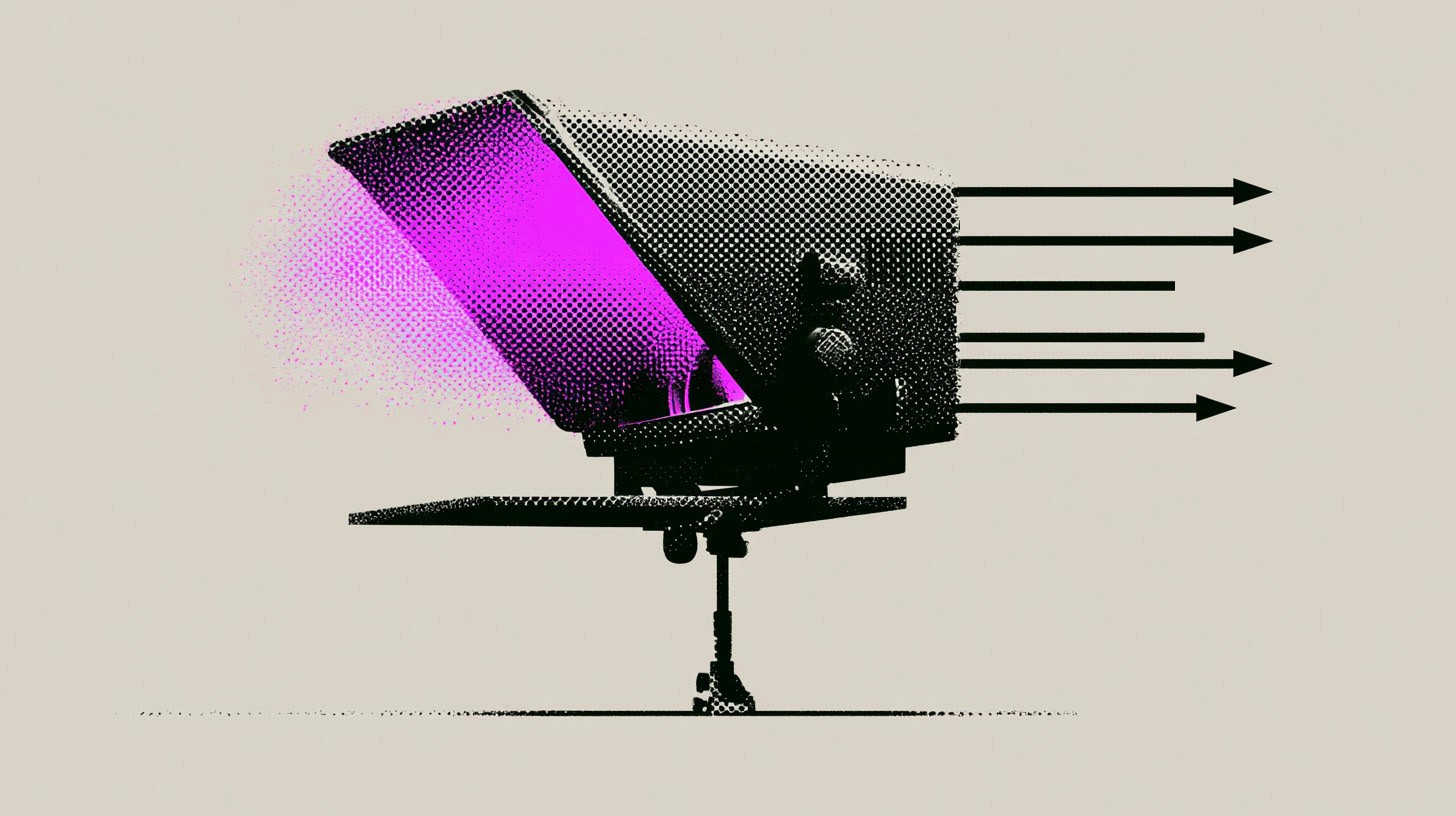
What speaks for the teleprompter?
The teleprompter has clear strengths – if used correctly:
Direct eye contact: Since the text is displayed directly in front of the camera lens, the speaker appears to look the viewer in the eye. That creates closeness and trust.
Precision with complex content: Numbers, technical terms, legal formulations – anyone who wants to make sure every word is right is well served with a prompter.
Time and cost savings: Especially busy CEOs benefit from fewer retakes being needed. The team knows what will be said – and that saves rounds of corrections.
Confidence in front of the camera: For anyone who fears forgetting important points, the teleprompter is a real support.
What speaks against the teleprompter?
The risks are real – and are often underestimated:
Inexperienced use shows immediately: Anyone working with a prompter for the first time falls into a monotonous reading rhythm. The eyes visibly move along the lines. Any authenticity is lost.
Overly polished texts feel alien: Print-ready sentences sound formal and distant when spoken. Viewers immediately sense when a CEO isn't speaking, but delivering a speech.
Personality gets lost: When voice, facial expressions, and content diverge, the opposite of trust is created. A perfect script can be the worst enemy of a good video.
What really works: the 70/30 rule
Experts recommend not an either-or decision, but a clear middle ground:
70 % preparation: Core message, numbers, and structure are internalized. That is the content foundation.
30 % room for the moment: The wording remains spontaneous. That makes the performance lively.
Anyone who plans 100 % and pre-forms every sentence leaves no room for the energy of the moment – exactly what keeps viewers on screen.
A proven alternative is the prompter with keywords instead of continuous text. Experienced speakers who know their topic come across more confidently this way than with fully formulated sentences.
Practical recommendation depending on the situation
Situation | Recommendation |
|---|---|
Complex figures, annual reports | Teleprompter with practiced text |
Personal video message to the team | Speak freely, keywords are enough |
LinkedIn video, short impulses | Speak freely, authenticity counts |
Keynote, product launch | Teleprompter after intensive training |
Crisis statement | Only with professional media coaching |
Conclusion: The technology is not the problem – preparation is
The teleprompter is neither a miracle cure nor the work of the devil. It is a tool. Whether it helps or hurts depends on how well the CEO is prepared and how much the text really sounds like spoken language.
Companies that show their leaders as real people with character – with occasional hesitation, genuine enthusiasm, their own voice – build a connection that no perfect script in the world can replace.
The most important question before every shoot: Would I say this to a friend over dinner too?